Compounded · Needle-free · Dual GLP-1 / GIP

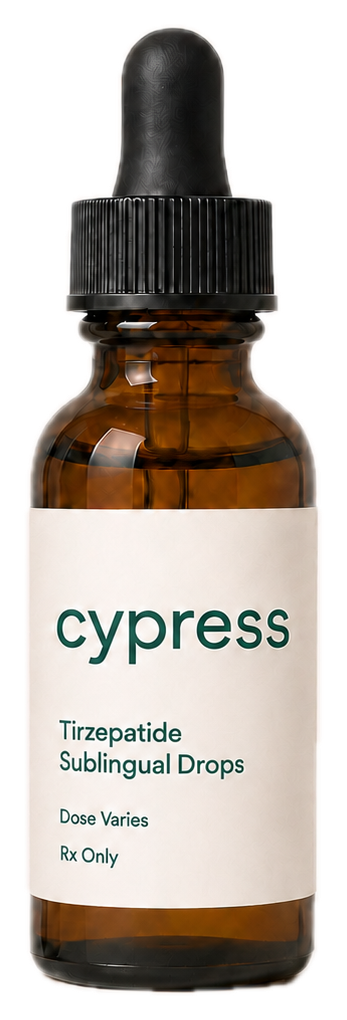
Tirzepatide Sublingual Drops

The dual mechanism — without the injection.

Tirzepatide acts on both GLP-1 and GIP receptor pathways. The sublingual format delivers that dual mechanism via daily under-the-tongue drops — an option for women who want the dual mechanism without a weekly injection. Whether it's appropriate for you is a clinical decision your clinician will make.

  • Needle-free — daily sublingual drops
  • Dual GLP-1 / GIP receptor activity
  • Compounded by a state-licensed U.S. pharmacy
  • Includes clinician oversight and ongoing support
  • Direct-to-door · cancel anytime on monthly · save more on 6 or 12-month plans
Start your assessment
Compounded tirzepatide sublingual drops — Cypress Health

Why this format

Tirzepatide's mechanism, delivered differently.

Compounded tirzepatide sublingual drops for weight loss

Sublingual tirzepatide is for women who want the dual GLP-1 / GIP mechanism but prefer daily routine over weekly injection. The bioavailability profile differs from injectable tirzepatide, and dosing is calibrated accordingly.

Whether the sublingual form is right for you depends on your medical history, your goals, and how you want care to fit into your life. Your clinician will help you decide between injection and sublingual.

A daily routine. Adjusted as you go.

1
Daily · Starting dose
A small starting dose under the tongue, held briefly before swallowing. Most patients tolerate the format well.
2
Weeks 4+ · Dose escalation
Your clinician adjusts your daily dose based on response and tolerance.
3
Ongoing · Care, not just refills
Plan includes oversight, adjustment, side-effect support, and check-ins.

Side effects & safety

What to know before you start.

Woman reviewing health information at home

Most common: nausea, decreased appetite, mild diarrhea, constipation, fatigue.

Less common but important: pancreatitis, gallbladder issues, low blood sugar.

Muscle mass during treatment: GLP-1 therapy can be associated with loss of lean mass, particularly in women in midlife. Your clinician will discuss strategies to protect muscle — typically resistance training and adequate dietary protein — as part of your care plan.

Not appropriate if: personal/family history of medullary thyroid carcinoma or MEN2; pregnant, planning pregnancy, or breastfeeding; severe GI or end-stage organ disease.

Compounded medication notice
Compounded sublingual tirzepatide is dispensed by state-licensed U.S. pharmacies in FDA-regulated facilities under the patient-specific 503A exception. It is not FDA-approved as a finished product.

Clinical evidence

In SURMOUNT-1 (Jastreboff et al., NEJM 2022), injectable tirzepatide produced up to ~20.9% body weight loss at the 15 mg weekly dose over 72 weeks — the largest published trial of a dual GLP-1/GIP receptor agonist for weight management.

Compounded sublingual tirzepatide uses the same active ingredient delivered via a different route. Outcomes from branded injectable clinical trials cannot be directly attributed to compounded sublingual preparations, and published human data for the sublingual route specifically is more limited.

Questions

Answers to
common questions.

How is this different from Mounjaro, Zepbound, or the injection?
Same active ingredient, daily under-the-tongue dosing — published evidence is more limited than for the injection.
Mounjaro and Zepbound are FDA-approved branded injectable tirzepatide manufactured by Eli Lilly. Compounded sublingual tirzepatide is prepared per-patient by a state-licensed U.S. pharmacy under the 503A exception — the same active ingredient delivered via daily under-the-tongue dosing instead of weekly injection. Sublingual is not FDA-approved as a finished product, and the published clinical evidence base for sublingual tirzepatide in humans is more limited than for the injectable form. Your clinician will help you decide whether sublingual is appropriate, or whether the injection's stronger evidence base is the right starting point.
How is the dual GLP-1/GIP mechanism delivered through drops?
Same molecule. Sublingual absorption differs from subcutaneous — your clinician sets the right dose for the route.
Tirzepatide acts on two appetite-regulating receptor pathways — GLP-1 and GIP. The active molecule is the same whether dosed by injection or by sublingual drops; what differs is delivery and bioavailability. Sublingual absorption through the tissue under the tongue avoids first-pass digestion, but the absorption profile differs from subcutaneous injection. Dosing schedules are not interchangeable between routes; your clinician will set the right dose for sublingual specifically.
When am I charged?
Not until a clinician confirms your eligibility and final pricing.
You're not charged when you submit. Your card is saved while a licensed clinician reviews your assessment, typically within 24 to 48 hours. If approved, you'll be notified by email and your final plan and pricing confirmed before any charge.
How will it ship — and how should I store it?
Ships via UPS or FedEx; storage instructions specific to your formulation will be included.
Once approved, the pharmacy ships within 1–2 business days via UPS or FedEx, Monday through Friday. Storage instructions specific to your formulation will be included with your shipment — most sublingual peptide preparations require refrigeration on arrival. If a shipment is lost or arrives damaged, we'll reship at no cost.
How quickly will I see results?
Most women notice appetite changes within 1–2 weeks at an effective dose.
Most women notice appetite changes within the first one to two weeks of an effective dose. The largest published outcomes data for tirzepatide and weight management — SURMOUNT-1 (NEJM 2022) — were generated using the injectable form. Outcomes from those trials cannot be directly attributed to sublingual compounded preparations, and there is less published human data for the sublingual route specifically. Your clinician will set expectations honestly based on your starting point, the dose you're on, and how your body responds.
Can I cancel? Will my insurance, HSA, or FSA cover this?
Cancel anytime on monthly. HSA/FSA usually accepted; insurance generally doesn't cover compounded.
The 1-month plan can be cancelled at any time. The 6 and 12-month plans are committed terms billed monthly — cancel future renewals after the term ends. Compounded GLP-1 medications are generally not insurance-reimbursable because they're prepared per-patient rather than as FDA-approved finished products. HSA or FSA cards are typically accepted for prescription medications; check with your benefits administrator to confirm eligibility for compounded medications under your specific plan.

Reserve your place. Start today.

The 3-minute medical screener is free. If you're a candidate, your clinician confirms your plan and pricing within 24 hours.

Start your assessment